

News Stories
Sponsored by Earth Etch. Regulatory insight and compliance solutions for today’s energy markets.
FERC Rules PG&E Ineligible For ROE Incentive Adder
FERC issues an Order Rejecting in Part, and Accepting and Suspending in Part, Proposed Formula Rate Filing, and Establishing Hearing and Settlement Judge Procedures re Pacific Gas and Electric Company under ER24-96.
FERC finds PG&E was ineligible for the ROE “incentive adder” because a 2022 state law requires California utilities to be CAISO members and bars them from leaving without California Public Utilities Commission approval, according to FERC. The ROE incentive aims to encourage utilities and other transmission owners to voluntarily join regional transmission organizations and ISOs.
FERC also finds, “PG&E’s participation in CAISO is no longer voluntary,” FERC said. “Thus, we find that PG&E is no longer eligible for the RTO Adder.”
FERC also rejected Pacific Gas and Electric’s request for an additional 0.5% return on equity — worth an estimated $41.4 million annually — as a bonus for being a member of the California Independent System Operator.
Excerpts From FERC Order Re RTO Adder:
{***}
We reject PG&E’s request for the RTO Adder.
In the Energy Policy Act of 2005, Congress added section 219 to the FPA, directing the Commission to establish, by rule, incentive-based rate treatments to promote capital investment in electric transmission infrastructure. The Commission subsequently issued Order No. 679, establishing the processes by which a public utility may seek transmission rate incentives pursuant to section 219. In November 2012, the Commission issued a Policy Statement providing guidance regarding its evaluation of applications for transmission rate incentives under section 219 and Order No. 679.
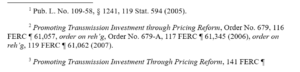
In Order No. 679, the Commission found that “entities that have already joined, and that remain members of, an RTO, ISO, or other Commission-approved Transmission Organization, are eligible to receive” the RTO Adder incentive and have a presumption of eligibility. The Commission explained that “the basis for the incentive is a recognition of the benefits that flow from membership in such organizations and the fact continuing membership is generally voluntary.”
Under a prior formulation of the California statute, the Ninth Circuit remanded the question of PG&E’s eligibility for the RTO Adder to the Commission and instructed the Commission to inquire “whether [PG&E] could unilaterally leave [CAISO] and thus whether an incentive adder could induce it to remain.” On remand, the Commission found that California law did not mandate PG&E’s participation in CAISO, and that the RTO Adder therefore induced PG&E to continue its membership. On appeal, in 2022, the Ninth Circuit upheld the Commission’s interpretation of California law.
However, as noted above, California has since amended its public utilities code and enacted a law, effective September 6, 2022, which requires that electrical corporations such as PG&E
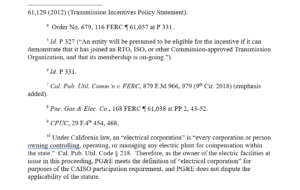
participate in CAISO, and may not withdraw from CAISO without CPUC approval. Section 1(a)(2)(b)(1) of Assembly Bill 209 provides that “It is the intent of the Legislature to . . . reaffirm that an electrical corporation currently participating in [CAISO] is not a voluntary participant.” Additionally, section 362(c) of California Public Utilities Code provides that “an electrical corporation . . . shall participate in [CAISO].”
Although PG&E argues that section 362(d) (“An electrical corporation shall not withdraw a facility from the operational control of [CAISO] without [CPUC] approval”) means that there is some dispute about whether PG&E is required to remain in CAISO, we disagree. Section 362(d) explicitly addresses the circumstances under which an electrical corporation can withdraw a particular facility from CAISO’s operational control, not whether the electrical corporation itself can withdraw.
Pursuant to Rule 217 of the Commission’s Rules of Practice and Procedure, the Commission may summarily dispose of a proceeding or part of a proceeding when it determines that there is no genuine issue of material fact. We are not persuaded by PG&E’s arguments that there is a disputed factual issue about whether PG&E’s ongoing participation in CAISO is voluntary and that the Commission should therefore set this matter for hearing and settlement judge procedures. To the contrary, we find that the issue presented is a legal question of statutory interpretation and that it can be resolved on the existing record.
Accordingly, we find that, by virtue of the recently enacted California statute, PG&E is required to participate in CAISO and cannot unilaterally withdraw from CAISO. As such, PG&E’s participation in CAISO is no longer voluntary. Thus, we find that PG&E is no longer eligible for the RTO Adder.
Likewise, we are not persuaded by PG&E’s attempt to distinguish this case from Dayton on the grounds that “the Ohio statute mandates participation and did not identify any statutory language that allows for withdrawal.” To the contrary, as discussed above, we find that the California statute does mandate participation and does not permit PG&E to withdraw from
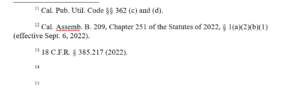
CAISO without CPUC approval. Moreover, we find it inapposite that, in Dayton, the Commission established a paper hearing to allow a full opportunity for parties to brief the issue, because the existing record is adequate to make a determination here. Therefore, we find that no further process is necessary. Finally, we find that the fact that Dayton is on appeal does not affect a finding here; an appeal does not require the Commission to put similar issues in a holding pattern pending resolution of the appeal.
https://elibrary.ferc.gov/eLibrary/filelist?accession_number=20231229-3012&optimized=false
https://elibrary.ferc.gov/eLibrary/#.

