

News Stories
Sponsored by Earth Etch. Regulatory insight and compliance solutions for today’s energy markets.
PA PUC Approves PECO’s Default Service Plan & New Shadow Billing Chart On First Page Of Shopping Customer Bills But Rejects Dropping Customer Referral Program Customers To Default Service At End Of Referral Term
The Pennsylvania PUC, in an order on PECO’s default service plan for the period June 1, 2025, through May 31, 2029, (DSP VI) approved, for residential shopping customers. The order also approves the implementation of a monthly bill chart, to appear on the first page of utility consolidated bills, which compares the costs for shopping customers under their retail supplier versus the amount that the customer would have paid under PECO’s price to compare.
This residential shadow-billed cost comparison chart will only list the total amount due under EGS service, in one column, and the amount that would have been due under default service, in a second column. The approved chart omits an earlier proposed column that would have presented, in dollar form, the additional costs, or savings, under retail supplier service versus default service.
See an example of the approved shadow billing comparison chart below.
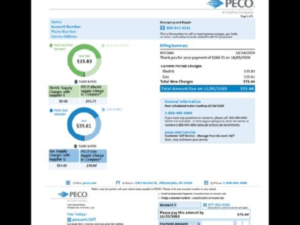
The PUC, in adopting the cost comparison chart for residential UCB customers, said that the information presented by the chart is “factual” and provides additional education and transparency
The PUC order found that the shadow-billed comparison chart is not anti-competitive because, among other reasons, the shadow-billed comparison chart, “provides no inherent judgments or conclusions regarding EGS [retail supplier] prices versus the PTC [price to compare]”.
In addressing supplier objections to the shadow-billed comparison chart, the PUC said that PECO will “continue” (i.e., no change to current requirements) to provide, as described by the PUC, “adequate” space on the UCB bill for retail suppliers to provide additional information to customers describing retail suppliers’ products and pricing.
Standard Offer Service:
In terms of the standard offer customer referral program (SOP), the PUC ordered that the current program should continue without modification. The PUC denied a proposal from a non-unanimous settlement to change the treatment of SOP customers who do not make an affirmative choice at the end of their SOP term.
Under the current program, customers remain with their retail supplier as assigned under the SOP program, on a rate determined by the supplier, with no early termination fee.
Parties to the non-unanimous settlement, which included PECO, the Office of Consumer Advocate (OCA), the Office of Small Business Advocate (OSBA) and other consumer advocates, proposed changing the SOP such that customers who do not make an affirmative selection at the end of their SOP term must be dropped to default service
The PUC found that parties in favor of this change did not adequately support with specific SOP-related evidence any harm from the current practice that would justify changing the prior design of the SOP adopted by the PUC in its retail market investigation and earlier default service plans.
Parties favoring the SOP change cited, in general, higher costs under retail supplier service than default service for residential customers (with residential shoppers paying $800 million more than the price to compare over six years. The Commission however said that such data applies to the entire residential shopping market and does not demonstrate any specific harm which may result to SOP customers who remain with their SOP supplier due to inaction.
The PUC said that proponents of the SOP change did not, for example, demonstrate higher complaints from SOP customers, or increases in arrearages or disconnections for SOP customers (though terminations for shopping customers, generally, was cited by some parties, the PUC noted that this data was not specific to SOP participants).
The PUC cited evidence demonstrating that 80% of respondents in an SOP customer satisfaction survey reported a positive experience with PECO’s SOP.
Moreover, the PUC generally cast doubt on the use of higher costs under retail supplier service versus default service as being dispositively indicative of customer harm, “because customers could be making shopping decisions based on factors other than price, such as the specific product offered or the length of the contract.”
The PUC said that, in the future, to the extent parties offer new evidence alleging harm to customers specifically from the SOP program design, the PUC would review such evidence on a “de novo” basis (in other words, the PUC would not grant deference to its finding related to the SOP from the case decided today).
Because the PUC rejected the contested settlement’s change to the SOP program, settling parties may withdraw from the settlement. The PUC gave parties five business days to indicate any withdrawal.
The PUC said that any withdrawal by a party would result in the PUC’s instant order adopting, with modification, the non-unanimous settlement being disapproved, and the entire default service plan would automatically be sent back to an ALJ for further proceedings.
Order (11/07/2024)
P-2024-3046008
Petition of PECO Energy Company for Approval of Its Default Service Program for the Period From June 1, 2025, Through May 31, 2029

