
Feature Articles
Have a topic request or want to submit an article? Contact the MAGNIFYI Editors
Competitive Electricity Is Failing? Look at Texas.
Why market design, not default-rate comparisons, determines success.

What if the biggest criticism of competitive electricity markets is based on the wrong metric?
For years, the debate has centered on a single question: Are customers saving money versus the utility default rate?
It’s a clean soundbite. It’s also the wrong scorecard.
Because default rates are not real-time reflections of the market, they are constructed prices, often based on forward purchases made months in advance. That timing gap alone creates distortions that critics routinely misinterpret as market failure.
Meanwhile, one market continues to outperform all others, not by accident, but by design.
What the Market Data Actually Reveals
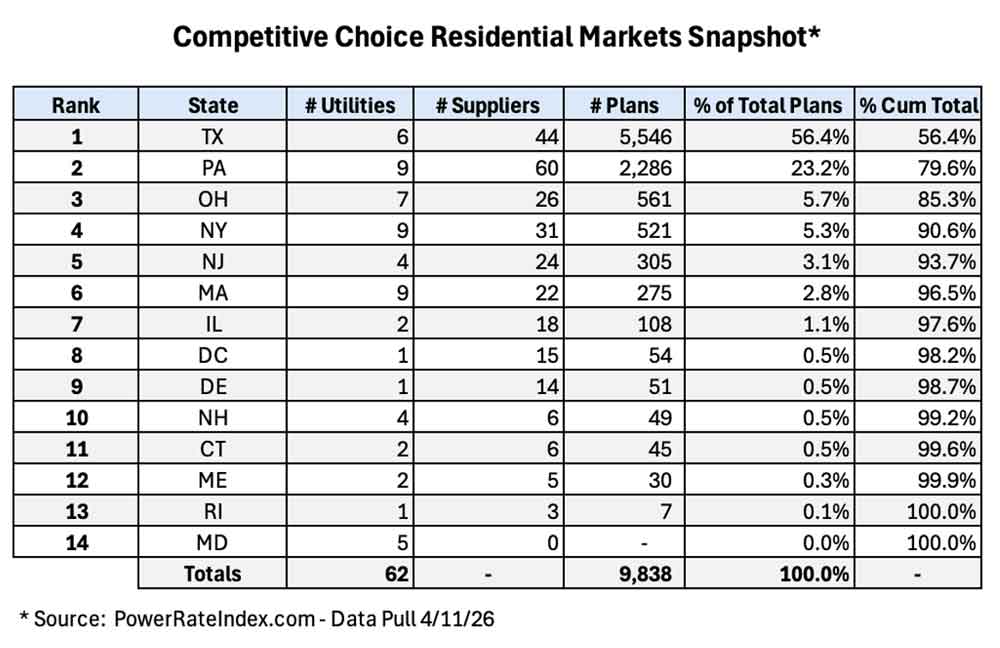
A recent data pull of posted residential customer plans from energy supplier, energy broker, and state-run shopping sites across major competitive markets illustrates just how much Texas stands apart.
Texas alone accounts for 56.4% of all residential competitive plans offered across U.S. markets, supported by 44 retail energy suppliers. Most Texas utility territories, excluding recently opened Lubbock Power & Light offer over 1,000 plan options for residential customers.
The Difference Is Market Design
This result is not surprising. Texas didn’t just introduce competition; it designed a market where competition can function and succeed for both customers and energy suppliers.
No Default Rate. No Passive Customers.
In most markets, customers are automatically placed on a utility default service unless they actively switch. That creates passive customers, low engagement, and limited competitive pressure.
Texas removed that friction entirely. There is no default rate. Every customer must choose a supplier.
Who Bills Defines the Relationship
In most states, the utility sends the bill with the competitive energy supply included only as a line item. Because of this, many customers don’t even know who supplies their energy.
That’s not true competition, it’s invisible participation.
Texas changed the model. The supplier bills the customer, includes both energy and T&D, and owns the relationship.
In Texas, customers know who their supplier is because that supplier owns the relationship.
Data Access Unlocks Innovation
Texas enables near real-time access to prospect and customer usage data, fueling time-of-use pricing, free nights and weekends plans, and innovative product design.
In Texas, competition isn’t limited to price, it extends to product design, customer experience, and how energy is used.
Other markets tend to rely on fixed-rate products with minimal differentiation.
Choice in Texas Is Structural
Texas supports thousands of plans and a dynamic ecosystem where suppliers continuously innovate and compete.
This level of choice is supported by a deep and active supplier base competing for every customer, not just a small segment of switchers.
Conclusion
The issue isn’t whether competitive choice works.
It’s whether markets are designed to let it work.
Judging these markets solely on default-rate comparisons ignores how competitive markets are designed to function.
Texas made critical design choices that enabled competition to thrive—and the results are clear.
Texas is working and it’s showing what competitive markets can achieve when they are designed to succeed.
Editor’s Picks

