
News Stories
Sponsored by Earth Etch. Regulatory insight and compliance solutions for today’s energy markets.
REAL Responds To Development & Publishing Of R Street Institute’s State-By-State Scorecard On Electricity Competition
The Retail Energy Advancement League (REAL) has issued the following statement in response to the development and publishing of R Street Institute’s State-By-State Scorecard on Electricity Competition. The following statement can be attributed to Chris Ercoli, the president and CEO of the Retail Energy Advancement League (REAL). REAL Press Release.
“The Retail Energy Advancement League is excited about this new resource that R Street Institute has created to help state leaders improve energy markets for consumers.
“This scorecard offers lawmakers and regulators in almost every state a clear, comparative assessment of how well they’re serving residents with electricity options — and, more importantly, where there’s room for improvement.”
“The results of this state-by-state analysis further highlight the limitations of monopoly utility markets when compared to restructured markets. Competition applies downward pressure on prices, drives innovation, empowers consumers, and enhances accountability — all while reducing exposure to unnecessary utility risks.”
“While the letter grades provide a benchmark, the scorecard’s true value lies in identifying where states may be underperforming and how they can learn from one another to deliver better outcomes for electric customers.”
“R Street has produced a valuable resource with this scorecard, especially at a time when state leaders are attempting to address energy affordability and reliability concerns. We believe it is in the best interest of state leaders to work toward enhancing electricity competition while improving consumer benefits –– and ultimately reaching A+ status.“
The R Street Institute’s State-By-State Scorecard on Electricity Competition can be found here.”
Executive Summary from R Street Institute’s State-By-State Scorecard on Electricity Competition is provided below:
“Electricity competition involves more than just allowing customers to choose their retail supplier.
It also requires making sure customers are aware of their ability to choose, encouraging them to choose their supplier, and keeping that choice visible to reinforce their decision. Currently, just over a dozen states give all of their customers the ability to choose their electricity provider. Other states have created hybrid models that offer some degree of choice. Each state has adopted its own set of rules to facilitate this process.
Although the ability to choose a supplier remains the primary benchmark for assessing electricity competition across the United States, additional strategies that support competition and choice can also factor into the overall picture of a state’s retail market, regardless of whether or not it offers full retail open access. These include:
- Allowing municipalities to aggregate residential customer demand
- Allowing smart-device companies to aggregate demand-side flexibility and production into wholesale markets or utility procurements
- Enabling the access and sharing of customers’ energy-usage data to optimize purchasing decisions around use patterns and available offerings
- Implementing utility procurement practices that enhance competitive selection, even if the costs are incorporated into the rates of the captive customer base
- Participating in an RTO
- Accessing a more liquid, competitive market upstream, constituted as an RTO
This scorecard describes the ways states can facilitate and enhance retail choice in electricity, assesses the degree to which each state is currently fostering competition and optionality, and suggests specific strategies each state can implement to further improve its retail electricity competition.
To assess each state’s level of retail choice, we first identified factors known to benefit consumer choice and then researched and verified which strategies each jurisdiction had implemented. States with existing retail choice programs were assigned a higher baseline grade; those without retail choice programs were assigned a lower baseline grade. We then applied our state-based research results and adjusted states’ scores to ensure that they reflected both the quality of any retail competition program as well as additional efforts and strategies known to be helpful in promoting retail electric choice.
Assessing states’ effectiveness in fostering electric competition in this way is important because competition exerts pressure on prices, promotes new markets, and creates savings for customers. Although full retail choice remains the ultimate goal, this scorecard illustrates that state regulators have additional tools they can deploy to bring competition to different parts of the utility business and enhance customer benefits.”
State By State Grades From R Street Paper:
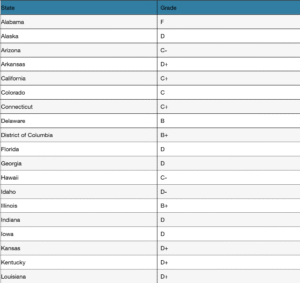
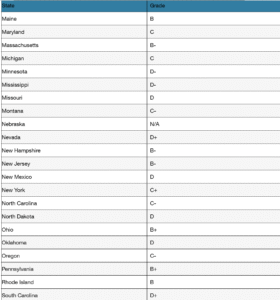
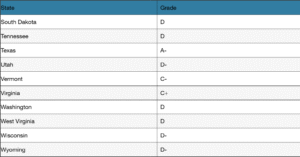
“Table 1: Retail Electric Competition Grades, by State
Table 1 summarizes the score given to each state and the District of Columbia, and the pages that follow provide a state-by-state scorecard that expands on our findings for each state and outlines recommendations for how each state can improve their retail electric competition.
Conclusion from R Street Report
“Looking across our assessments, several key findings emerge.
Successful states have established retail customer choice, implemented robust data access policies that leverage standardized protocols like Green Button Connect, and developed effective consumer education and protection frameworks. However, many states continue to lag in critical areas by failing to provide meaningful choice in electricity supply, maintaining barriers to data access and sharing, and offering limited consumer information or weak complaint resolution processes. Even in states with some competitive elements, implementation challenges often diminish benefits to consumers.
In a scorecard assessing electricity competition, it is not surprising that the states that allow retail choice received the highest grades. Specifically, restructured states with retail choice and RTO participation consistently scored the highest, mostly in the B range. Texas achieved the scorecard’s highest grade: A-. States in the hybrid category, which maintain regulated monopolies while participating in RTOs, showed marginally better performance than traditional states, with a few achieving grades in the C range and most landing in the D range. States that maintain the traditional regulated monopoly model without RTO participation performed the poorest, with no grades above C- and several F grades. This pattern suggests that although RTO participation offers some benefits, the greatest gains in consumer choice and market efficiency come when full restructuring is combined with effective implementation.
Every state has opportunities to enhance competition and improve consumer benefits, regardless of their current market structure. States using traditional models can take meaningful steps toward competition by joining RTOs and enabling access to competitive procurement. Hybrid states can build on their RTO participation by expanding customer choice and implementing robust, competitive procurement processes. Even high-performing, restructured states have room for improvement in areas like supplier-consolidated billing and data access. However, the evidence is clear that meaningful reform cannot wait. Consumers in states that maintain traditional monopoly structures are missing out on significant benefits that competition can deliver. We encourage states to take concrete steps toward implementing competitive frameworks that can better serve their consumers.”
If you want to subscribe to their emails, you can do so at: https://www.rstreet.org/connect/.
For the full details of each state’s grade, see the original report here.”
Editor’s Picks

