
Feature Articles
Have a topic request or want to submit an article? Contact the MAGNIFYI Editors
Retail Energy Is Under Assault in Many States, Conference-Goers Told
Retail energy choice is under attack in many states, speakers said at a conference in Washington, D.C., last week, but expansion into new states is in the works.

“In a few markets, the house is on fire,” Frank Caliva, the national spokesperson for the Retail Energy Supply Association, said at a panel at the EMC26 Conference.
“Some fires were put out, but will keep coming back,” he added. “We also are building new houses.”
Retail power choice in the 14 states that allow it will erode over if the industry only tries to protect its markets, said Chris Ercoli, CEO of the Retail Energy Advancement League.
“We must expand,” Ercoli said. “In the last 24 months, we have templated 14 or 15 [new] markets with legislation.”
The league wants to introduce power choice for commercial and industrial customers to a limited degree in utility service territories in more states.
A Maryland law adopted in 2024 that imposed strict regulations on the industry is one example of the threats faced by the industry.
Senate Bill 1 adopted that year has required individual energy marketers to obtain licenses, which resulted in a total withdrawal of offers for residential retail power customers.
The law also prohibited the sale of receivables of retail residential accounts, increased penalties for infractions, prohibited commission-based compensation for salespeople and eliminated early termination fees.
The league sued Maryland over the bill, Ercoli said, and an appellate court found that the law was unconstitutional in determining the terms and conditions of green power.
“We are trying to figure out the severability of SB1,” he told the audience.
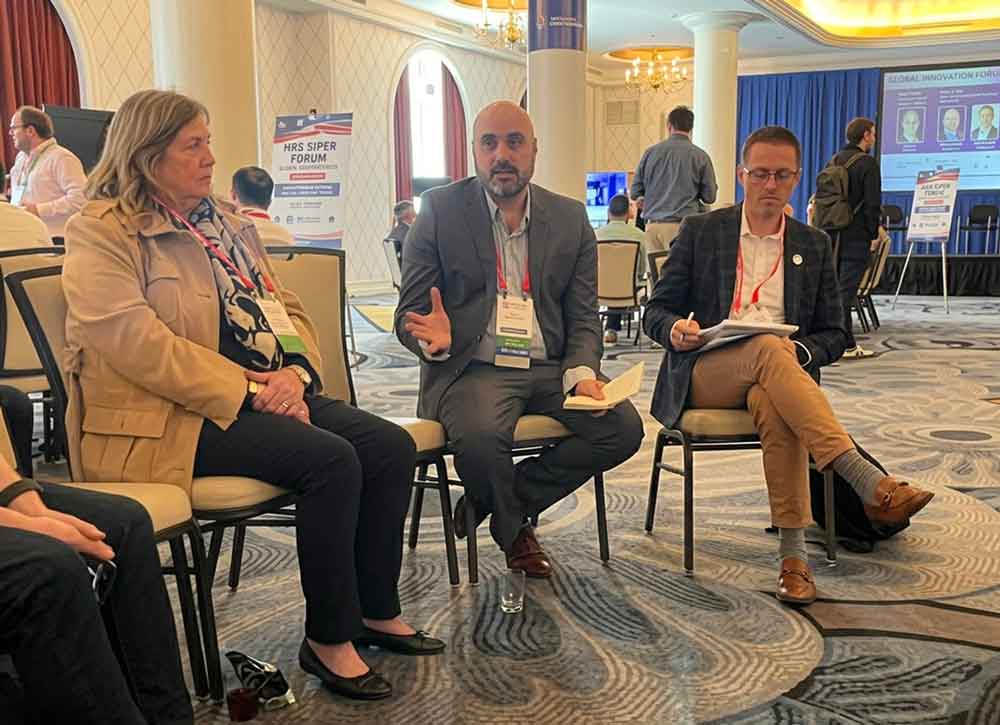
Left to Right: Tracy McCormick, Frank Cavali, Chris Ercoli
Severability is the principle that if one part of a statute is unconstitutional, the rest of the provisions remain valid.
In the meantime, recent price surges in the PJM Interconnection may make retail choice attractive again.
“Maryland legislators are asking for [choice] at a time when prices are up,” Ercoli said. “This also has played out positively for us in Massachusetts and Delaware.”
In Maryland, Ercoli said the league hopes to end a retail price cap, place licensing at the company level and not on individual salespeople and allow automatic renewals if customers consent at the time of enrollment.
“Otherwise, you are slamming them back to [utility] service, which is no different than slamming them in the first place,” he said.
Slamming is the unauthorized practice of switching a customer’s supplier without their clear knowledge.
Bills similar to that of Maryland were introduced in Delaware and in the District of Columbia.
Delaware Governor Matt Meyer (D) vetoed a bill late last month to mandate monthly reporting by suppliers, to require customer signatures for rate changes and to cap rates. He said that some aspects of the bill would stifle competition.
In the District of Columbia, a city of nearly 700,000 people, a pending bill in the city council broadly targets the retail energy industry.
The bill, B26-0750, includes price caps and allows residential customers to terminate third-party energy service at any time without high penalties.
“The [city] Department of Energy and Environment is against choice in D.C.,” Ercoli said.
The city Public Service Commission said it will delay changes to the purchase of receivables until the city council casts a final vote on the bill.
Ercoli said a bill is introduced in the Massachusetts senate every year to end consumer energy choice.
The Massachusetts attorney general released a report in March claiming that residential customers who switched to competitive supply paid $738.7 million more on their electric bills than they would have paid if they stayed on basic service in the last decade.
The report said competitive electric suppliers charge low-income customers higher rates than non-low-income customers, and this practice harms all ratepayers.
Ercoli questioned the methodology behind these findings. Few consumers in the state have complained about the industry this year, he said, but the complaints that were filed show egregious charges.
Cavali said his association spends a lot of time on “regulatory contagion.”
Natara Feller, an attorney who spoke on another panel at the conference, said New York state requires that retail providers receive consent from customers before implementing a price change. The law went into effect in 2023.
Feller said some provider contracts have monthly price changes, which does not allow enough time to comply.
New York state regulators also adopted rigid requirements for fixed price contracts in November.
Developments in New York state tend to flow westbound and into other sectors, she added.
Retail natural gas sales may not be regulated in the same manner as the power sector.
Misti Day, vice president at Spark Energy, said at the conference that 20 states allow retail gas sales.
“There is a lot of load at small businesses, and gas is an easy sale,” said Charles de Casteja, managing partner at Good Energy. “It is the stickiest business we have.”
Consumer Experiences Matter
Speakers throughout the event, attended by around 300 people, said that the retail energy industry needs to bring positive consumer experiences to the attention of government officials.
“What regulators care about are prices, consumer protection and value,” Cavali said. “We need to elevate our good voices and make our negative voices less frequent.”
Consumer protection language to ban bad actions is not enough, Ercoli said. “We need to make sure customers talk to lawmakers with their experience,” he said. “We need to activate our educated customers.”
Editor’s Picks

