
Feature Articles
Have a topic request or want to submit an article? Contact the MAGNIFYI Editors
Does Your Company Really Need a Tagline?
Why brand strategy matters more than finding the perfect tagline.
Over my marketing career, I’ve lost count of how many times a client or executive has told me, “We need a great tagline.”
Sometimes they already have one they love. Other times, they’re convinced that finding the perfect three or four words will somehow transform their brand. Everyone has an opinion. The CEO likes one version. Sales prefers another. Before long, the discussion becomes a debate over clever phrases and personal preferences.
But I’ve learned that the most important question isn’t what the tagline should say. It’s what the tagline is supposed to accomplish.
I’ve spent more than 35 years in marketing, beginning in consumer packaged goods and later working in technology, transportation, and competitive retail energy. Across these industries, I’ve seen organizations devote considerable attention to taglines without first establishing the strategic foundation needed to evaluate them.
A great tagline can make a brand memorable, reinforce its positioning, and become a source of employee pride. But before starting the creative process, I think more companies should ask: Does our company really need a tagline?
First Understand What a Tagline Is Supposed to Do
A tagline is a short, memorable expression of a brand’s positioning, promise, or personality. Consider some familiar examples:
- Nike: “Just Do It.”
- BMW: “The Ultimate Driving Machine.”
- M&M’s: “Melts in Your Mouth, Not in Your Hand.”
- L’Oréal: “Because You’re Worth It.”
Nike expresses an attitude toward achievement. BMW makes a performance promise. M&M’s communicates a tangible product benefit. L’Oréal connects its products to confidence and self-worth.
None attempts to explain everything the company does. A tagline isn’t a miniature corporate brochure. Its job is to reinforce a central brand idea customers can remember. But the company must first understand what that idea is.
Start at the Center of the Brand
Early in my marketing career, I was introduced to David Aaker’s work on brand identity and positioning. Over time, I adapted his concepts into a practical methodology for establishing communications priorities and evaluating creative work.
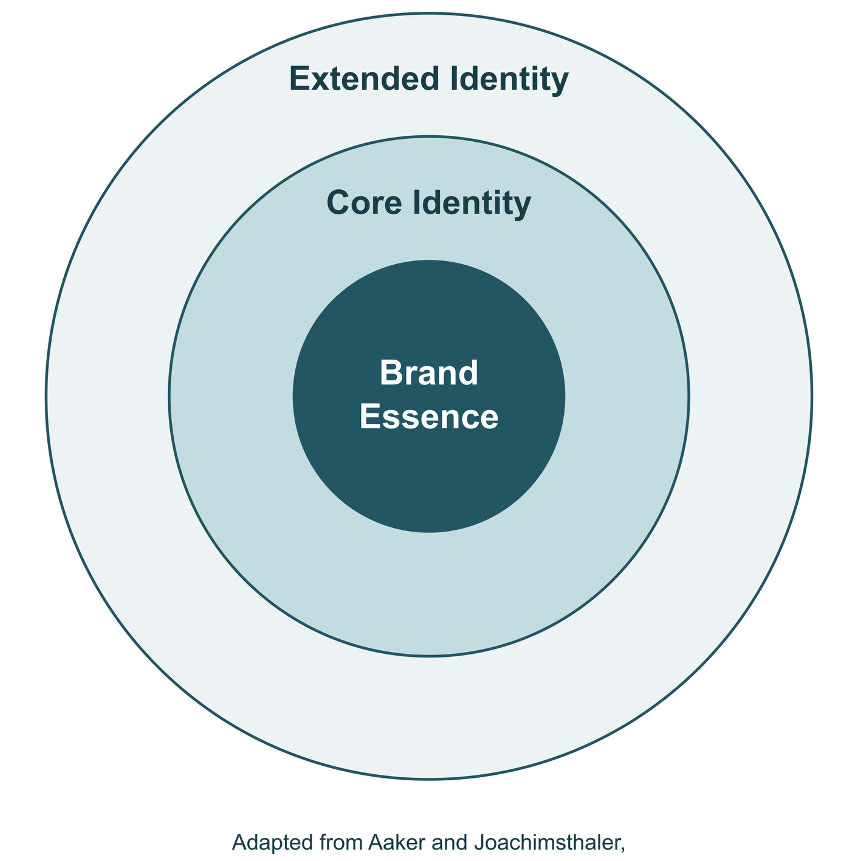
The structure developed in Aaker and Erich Joachimsthaler’s Brand Leadership includes Brand Essence, Core Identity, and Extended Identity. The diagram illustrates those relationships: a central brand idea, the core elements that define the brand, and additional elements that give it richness and detail.
Deciding What the Brand Should Communicate
My adaptation uses concentric rings to establish a hierarchy of communications priorities. Aaker’s published structure organizes brand identity; I use it as a starting point for deciding what communications should emphasize. The priority levels in my example below are my application, not additional categories from Aaker’s model.
I begin with the Brand Essence, the fundamental idea the brand stands for. Attributes closer to the center receive greater communications emphasis. Farther out are supporting messages that can be used selectively, depending on the audience, medium, and objective.
Aaker treats a concise Brand Essence statement as optional. In my process, agreeing on the central brand idea provides a useful foundation, even when that idea isn’t expressed in a polished phrase.
Not every advertisement, website page, or sales presentation needs to communicate every attribute. But every communication should remain consistent with that central idea and reinforce the appropriate priorities.
Why This Changes the Creative Process?
I prefer to work with management to establish the Brand Essence and supporting priorities before introducing advertising copy or tagline concepts. Executives can usually agree on the attributes they want their brand to represent more easily than on the words used to express them.
Once we have that agreement, we can replace “I don’t like that tagline” with more productive questions. Does it reinforce our Brand Essence? Does it communicate a priority attribute? Is it meaningful to our audience and consistent with our positioning? Is it on strategy?
That doesn’t eliminate creative judgment. It gives judgment an agreed-upon objective. In my experience, that produces better marketing and a more productive management process.
What M&M’s Can Teach Us About Brand Essence?
I’ve encountered Carefree Joy as a description of M&M’s brand essence. I use it here as an illustrative characterization, not an authenticated internal brand statement.
“Melts in Your Mouth, Not in Your Hand” doesn’t mention joy. It communicates a functional benefit: enjoying chocolate without the mess. That benefit supports an emotional experience of carefree enjoyment, reinforced by colorful characters, humor, and playful advertising.
The lesson is that a tagline doesn’t necessarily have to state the Brand Essence. It needs to reinforce it.
Nike offers another illustration. “Just Do It” doesn’t describe shoes or product performance. It expresses a motivating attitude toward achievement. Decades of advertising, athlete endorsements, product innovation, and customer experiences have given those words meaning.
The tagline doesn’t create the brand’s meaning by itself. The entire brand communications system gives the tagline its meaning.
What This Means for Retail Energy Suppliers?
Competitive electricity suppliers deliver the same underlying commodity. Differentiation must come from pricing structures, risk management, service, technology, renewable energy options, operational capabilities, financial strength, or the customer experience.
Yet much of the industry’s marketing uses similar words: power, energy, better, smarter, future, together. There’s nothing inherently wrong with them. But do they establish meaningful differentiation?
Consider three possible positions. A residential supplier might emphasize Peace of Mind, supported by predictable pricing, responsive service, and straightforward billing. A technology-oriented supplier might emphasize Customer Control, supported by usage transparency, digital tools, and flexible products. A renewable energy supplier might emphasize Environmental Responsibility, supported by renewable products and credible environmental commitments.
Each could lead to different creative expressions. The best tagline for one might be inappropriate for another. Without establishing the Brand Essence and communications priorities, what exactly are we evaluating?
A Hypothetical Example of My Approach
Imagine a supplier whose Brand Essence is Customer Confidence. My communications-priority hierarchy might look like this:
| Communications priority | Brand attributes |
| Center: Brand Essence | Customer Confidence |
| Inner ring: Essential attributes | Reliability, Transparency |
| Middle ring: Important differentiators | Expertise, Responsive Service |
| Outer ring: Supporting attributes | Technology, Product Flexibility, Sustainability |
Now imagine three tagline concepts: one emphasizes low prices, another innovation, and a third confident energy decisions.
Without a framework, the decision might come down to personal preference. With it, management can assess how each reinforces Customer Confidence. Low prices might conflict with the intended positioning. Innovation might emphasize a supporting attribute while overlooking the central promise. The confidence concept might be less clever but more strategically relevant.
That doesn’t automatically make it the winner. Creativity, differentiation, credibility, and memorability still matter. The framework gives us a better starting point.
Does Every Company Need a Tagline?
Every company needs a clearly defined brand strategy. Not every company needs a tagline. Its value depends on the business model, audience, objectives, and communications channels.
A website homepage has room to explain purpose, capabilities, and customer value through headlines, supporting copy, imagery, and testimonials. For a commercial and industrial supplier, a clear headline explaining how it helps businesses manage electricity costs and market risk may be more useful than a clever three-word tagline.
Visitors often want information that helps them assess capabilities and credibility. A tagline may add little to that task.
Television Is a Different Story
For a residential supplier investing heavily in television, a tagline can connect a commercial’s specific benefit or emotional story to the broader positioning. It can also create continuity: one advertisement emphasizes predictable pricing, another service, and another energy management tools. A consistent tagline connects those different attributes to the same brand promise.
Social Media Depends on the Objective
A tagline can reinforce recognition across coordinated campaigns using short videos, graphics, and sponsored content. But educational posts, customer service messages, and industry commentary may work better without a repeated slogan.
The objective is consistency with the strategy, not mechanical repetition. The medium and marketing objective should help determine whether a tagline adds value.
Remember the Internal Audience
A memorable tagline can give employees a concise expression of what their company stands for. BMW’s “The Ultimate Driving Machine” expresses an ambition that engineers, designers, salespeople, and service employees can understand.
For an energy supplier, a compelling tagline could connect sales, pricing, operations, technology, finance, and customer service around a shared customer promise. When employees believe in that promise, it can become a source of excitement and pride.
But a tagline can’t manufacture pride when the company doesn’t deliver. If advertising promises exceptional service while employees see routine customer problems, the words may inspire cynicism. The strongest taglines reflect an authentic commitment, not simply what management wishes the company could be.
How I Evaluate a Tagline
Once the strategy is established, I recommend consistent criteria:
- Strategic alignment: Does it reinforce the Brand Essence and priority attributes?
- Differentiation: Is it distinctive, or could any competitor say it?
- Customer relevance: Is it meaningful to the intended audience?
- Credibility: Can the company deliver on its implied promise?
- Memorability: Is it concise, recognizable, and easy to recall?
- Versatility: Does it work across the channels where it will appear?
- Longevity: Will it remain relevant as products and markets evolve?
- Internal relevance: Can employees believe in it and take pride in delivering it?
I wouldn’t weight these equally. Strategic alignment, differentiation, and customer relevance should generally outweigh cleverness or personal preference. Before selection, companies should also conduct appropriate competitive and trademark reviews.
The Best Tagline May Be No Tagline at All
I’ve learned that creative development becomes more productive when management agrees on strategy before debating words. A great tagline can reinforce positioning, connect campaigns, build recognition, and give employees a shared sense of purpose. A generic one can consume space without contributing much.
Sometimes a clear purpose statement, compelling value proposition, and consistent supporting messages accomplish more.
Before debating “Powering Tomorrow” versus “Energy for What’s Next,” I’d start with different questions. What is our Brand Essence? Which attributes should customers associate with us? What makes us meaningfully different? How should communications reinforce those priorities?
Those answers will help determine whether you need a tagline and, if you do, how to develop and evaluate it.
The question isn’t whether management likes the tagline. The question is whether the tagline does its job.
Editor’s Picks

