
Feature Articles
Have a topic request or want to submit an article? Contact the MAGNIFYI Editors
The Real Reason Retail Energy Marketing Falls Short

Most discussions about competitive energy markets focus on Pricing, Switch Rates, and Sales Channels.
But those categories don’t explain the most important question:
Why do Customers behave the way they do?
After more than two decades of Competitive Energy Markets, one thing has become clear—Customers don’t all think, act, or make decisions the same way. Yet much of the industry still approaches the Residential market as if they do.
In reality, Residential Energy Customers fall into three distinct behavioral segments. And understanding those segments is the key to building more effective Marketing Strategies, improving conversion rates, and ultimately growing market share.
Three Segments That Define the Market
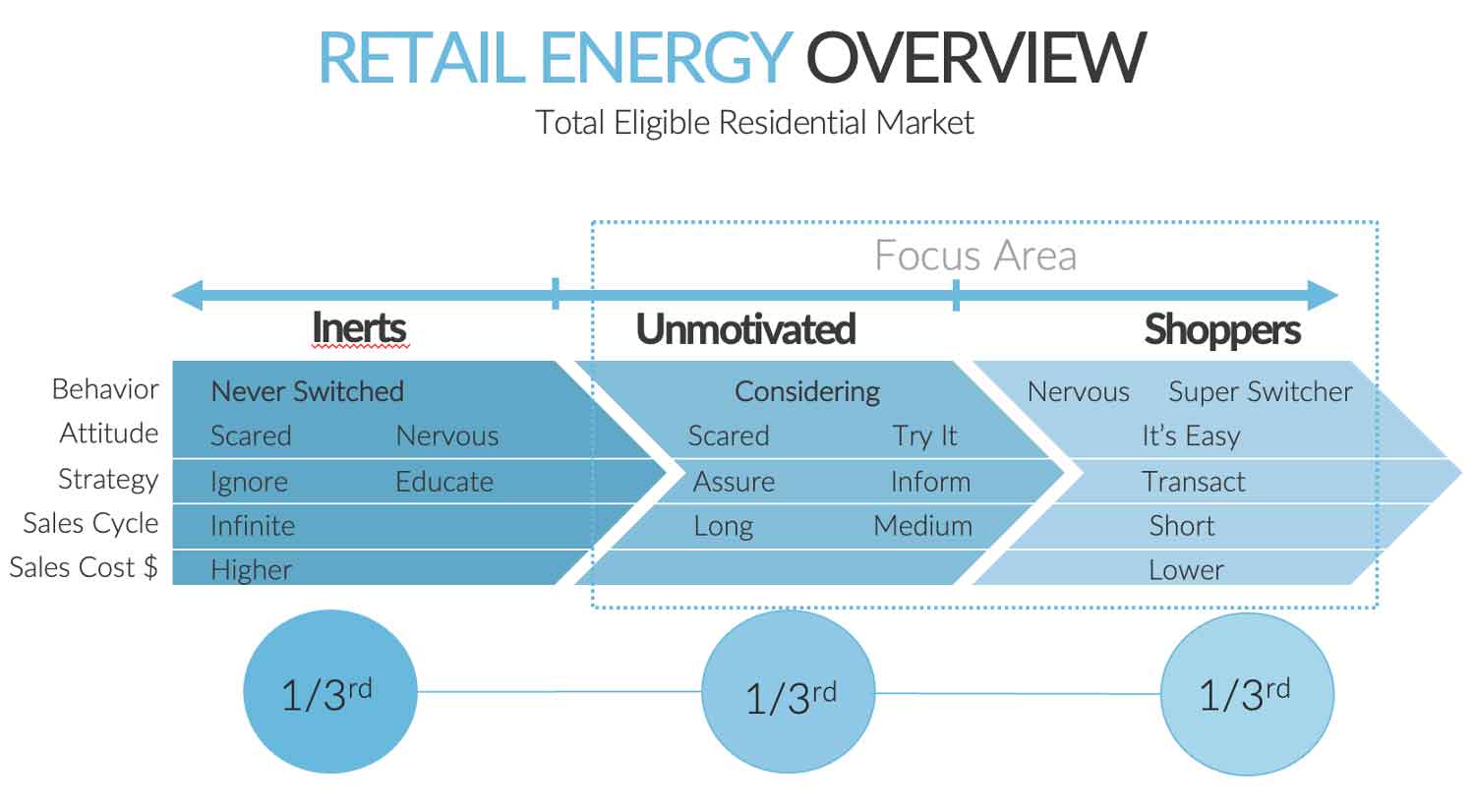
Based on qualitative research and focus groups conducted early in the evolution of competitive markets—and still highly relevant today—I group Residential Customers into three foundational segments:
1. The Inerts
These are customers who have never switched suppliers.
They tend to be:
- Risk-averse
- Skeptical of Change
- Comfortable staying with what they perceive as the “Safe” option
For these Customers, electricity is not a category they want to engage with. The perceived downside of making the wrong decision outweighs any potential savings.
From a Marketing perspective, this is the most difficult and expensive segment to convert:
- Long (or effectively infinite) Sales Cycles
- High Acquisition Costs
- Low Responsiveness to Traditional Marketing
For most Suppliers, the most rational strategy is simple:
Don’t chase them.
2. The Unmotivated
This is the most important segment—and the most misunderstood.
These customers:
- Are Aware They Have a Choice
- Have Considered Switching
- But Haven’t Taken Action
They often lack:
- Confidence
- Sufficient Understanding
- A Clear Reason to Act
They are not opposed to switching—they’re just not convinced it’s worth the effort or risk.
This segment represents the largest opportunity in the market.
Unlike the Inerts, they are reachable. Unlike active shoppers, they are not purely price-driven. But they require a different approach:
- Education
- Reassurance
- Simplification
- Clear value
For this group, Marketing isn’t about Selling—it’s about building confidence.
3. The Shoppers (or “Master Switchers”)
These are the most active participants in the market.
They:
- Have Switched Multiple Times
- Are Highly Price Sensitive
- Are Comfortable Evaluating Offers
For them, switching is easy.
From a supplier perspective:
- Short Sales Cycles
- Lower Acquisition Costs
- But Lower Margins, Higher Churn and less Customer Loyalty
This is a transactional segment.
Success here depends on:
- Pricing Competitiveness
- Frictionless Enrollment
- Efficient Digital Experiences
The Industry’s Core Mistake
The biggest mistake in Retail Energy Marketing is not recognizing the differences between these segments.
Too often:
- Marketing Dollars are Spent Trying to Convert Inerts
- Pricing Strategies are Designed for Shoppers
- and the Unmotivated Segment is Largely Overlooked
But that’s where the real opportunity lies.
The Unmotivated Segment is where Markets Grow.
Strategy Should Follow Behavior
Each segment requires a fundamentally different approach:
Customer Behavior—not pricing alone—drives how and where suppliers should compete.
This isn’t just a Marketing framework—it’s a Resource Allocation Model.
Winning Suppliers understand where to focus—and where not to.
What Texas Reveals About Customer Behavior
One of the clearest real-world examples of this segmentation model can be seen in Texas.
Despite more than 25 years of competitive energy markets, the incumbent retail providers—Reliant and TXU—have retained a powerful position with a significant portion of the residential customer base. For many consumers, these brands continue to represent “the energy company” or the default, safe choice, even though the traditional utility model no longer exists in the same way.
These customers are largely what can be described as the “Inerts”—households that have never switched suppliers, often driven by risk aversion, habit, and a long-standing association between reliability and the incumbent brand.
However, this segment is not static.
Over time, the number of these customers is gradually declining. As older, more risk-averse consumers age out of the market, they are being replaced by customers who are more aware of choice and more willing to engage. This shift is contributing to the gradual decline in market share among the largest incumbent providers, as shown in prior analysis.
In this way, market share dynamics in Texas are not simply the result of pricing or competitive tactics—they reflect the slow but steady evolution of customer behavior across generations.
Why This Matters Now
The timing of this shift is important.
For years, reaching Residential Customers at scale required:
- Door-to-Door Sales
- Outbound Telemarketing
- Mass Marketing Campaigns
Those approaches were often inefficient—and in many cases, damaging to the industry’s reputation.
Today, that is changing.
Advances in:
- Smart Meter Data
- Digital Platforms
- Artificial Intelligence
are making it possible to engage customers differently.
These tools allow suppliers to:
- Better Understand Customer Behavior
- Tailor Messaging and Pricing
- Reduce Acquisition Costs
Most importantly, they make it possible to effectively reach the Unmotivated Segment—at scale.
The Next Phase of Competitive Energy Markets
The next phase of market development will not be driven by more suppliers or more aggressive pricing.
It will be driven by:
- Better Segmentation
- Smarter Targeting
- More Relevant Customer Experiences
The suppliers that succeed will not be those who try to sell to everyone.
They will be the ones who understand:
- Who to Target
- How to Engage Them
- and What Matters to Them
Conclusion
Competitive Energy Markets have spent decades focused on Pricing, Switch Rates, and Sales Channels.
But the real driver of market growth is Customer Behavior.
The future of Competitive Energy Markets will not be won by those who shout the loudest or price the lowest.
It will be won by those who understand their Customers best.
And design and execute their strategies accordingly.

