
Feature Articles
Have a topic request or want to submit an article? Contact the MAGNIFYI Editors
What Makes Your Retail Energy Supplier Unique?
Why Most Energy Brands Struggle to Stand Out

Over the years, I’ve had the opportunity to work with a number of retail energy companies on branding, positioning, and marketing strategy.
One question consistently emerges during those discussions:
What makes us unique?
At first glance, the answer seems obvious.
Companies often point to customer service, competitive pricing, innovative products, digital capabilities, or ease of doing business.
Those are all important attributes.
The challenge is that competitors often say the same things.
When every company claims great service, competitive pricing, and customer focus, those attributes stop feeling unique. They become expected.
That doesn’t mean companies aren’t different.
It simply means that the true source of differentiation may lie deeper beneath the surface.
And that’s where things get interesting.
Looking Beyond Marketing
When branding comes up, conversations often focus on visible marketing elements such as logos, websites, advertising campaigns, and taglines.
Those things are certainly important.
They’re often the most visible expression of a brand.
But I’ve come to believe that the strongest brands are built on something deeper.
They’re built on the value a company creates and the way it creates that value.
Which leads to a more fundamental question:
Why should a customer choose you instead of a competitor?
What do you actually do differently that creates value?
What makes you unique in the customer’s mind?
For many suppliers, that’s where the conversation becomes more challenging.
Because when you step back and look at the retail energy industry, many providers appear remarkably similar. They buy energy, manage risk, enroll customers, send bills, and provide customer service.
When customers struggle to see meaningful differences, price naturally becomes a more important part of the decision.
And that’s a difficult place for any company to build a sustainable competitive advantage.
Michael Porter’s Insight
In his landmark Harvard Business Review article, “What Is Strategy?”, Harvard Business School professor Michael Porter explored why some companies consistently outperform their competitors.
One of Porter’s most important insights was that sustainable competitive advantage rarely comes from a single capability, product feature, or marketing claim.
Instead, it comes from a unique system of activities that competitors find difficult to replicate.
In other words, successful companies are rarely unique because they do one thing better than everyone else.
They become unique because they do many things differently—and those activities reinforce one another.
Southwest Airlines is perhaps the most frequently cited example.
Its advantage was never simply low fares.
Low fares were the result of a carefully designed operating system that included point-to-point routes, standardized aircraft, simplified operations, fast gate turnarounds, and high aircraft utilization.
Each activity reinforced the others.
Together, they created a system that competitors found difficult to replicate.
The same principle applies in retail energy.
Seeing Your Business Differently
Several years ago, I led a cross-functional team through an exercise to identify and map a retail energy supplier’s activities using Michael Porter’s Activity System Model.
It proved to be one of the most valuable strategic exercises I have ever participated in.
What emerged was not simply a diagram of business activities.
It became a visual representation of how the company created value for customers.
Perhaps more importantly, it helped team members better understand how their individual efforts contributed to the company’s overall success.
Activities that were often viewed as separate functions suddenly became connected.
Team members could see how decisions made in one area influenced outcomes in another.
The exercise also helped us identify the activities that truly created value for customers and, ultimately, the factors that made the company unique in the marketplace.
That is not an easy task in a product category that many consumers view as a commodity.
What became clear was that the company’s competitive advantage wasn’t any single activity.
It was the way those activities worked together.
That’s often where uniqueness lives.
Not in a slogan.
Not in a website.
Not even in a product.
But in the unique way a company operates.
Figure 1. Example of a Retail Energy Activity System Map
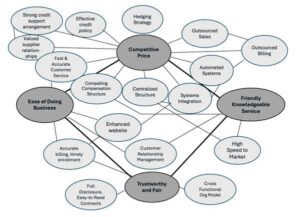
What I found particularly valuable about the exercise was that it produced much more than an interesting diagram.
The goal wasn’t to create a better brand message.
The goal was to better understand how the company created value.
The stronger brand message emerged from that understanding.
The activity map helped clarify the company’s competitive positioning. It highlighted the specific activities that created value for customers and identified the company’s most important value drivers.
Those value drivers became the foundation for sharper positioning, more focused messaging, product development priorities, marketing strategies, and operational decision-making.
In many ways, the exercise helped the company move from simply talking about value to understanding exactly how value was created.
Once that became clear, communicating the brand became much easier.
What This Might Mean for Retail Energy Suppliers
One of the things I’ve always found fascinating about the retail energy industry is that many suppliers perform remarkably similar functions.
Yet some consistently outperform others.
Why?
I suspect the answer often lies beneath the surface.
Many suppliers describe their uniqueness in terms of outcomes. They point to customer satisfaction, enrollment speed, digital capabilities, pricing, or service quality.
Those outcomes certainly matter.
But they may not be the source of the advantage.
They may be the result of it.
The more interesting question is:
What allows a company to consistently deliver those outcomes while competitors struggle to do the same?
Perhaps it’s superior customer insights.
Perhaps it’s a unique broker strategy.
Perhaps it’s better systems, stronger analytics, faster decision-making, or a more disciplined operating model.
Individually, none of those activities may seem unique.
Together, they may create a system that competitors find difficult to copy.
And that system—not the marketing message—is often where true differentiation resides.
Why It Matters Now
The retail energy marketplace is becoming increasingly transparent.
Customers can compare suppliers online within minutes. Shopping sites place dozens of offers side-by-side. Artificial intelligence is making information easier to access than ever before.
As transparency increases, meaningful differentiation becomes increasingly important.
Companies that struggle to articulate what makes them unique often find themselves competing primarily on price.
Companies that understand and strengthen their unique activity systems may have greater opportunities to create value beyond price—and build stronger brands in the process.
MAGNIFYI® Takeaway
One of the most valuable lessons I’ve learned from studying brands—both inside and outside the retail energy industry—is that meaningful differentiation rarely comes from a slogan, a website, or a marketing campaign.
More often, it comes from the way a company operates.
The systems it builds.
The choices it makes.
And the activities that work together to create value for customers.
Before asking what your company should say, it may be worth asking a different question:
What makes your company unique?
The answer may reveal the foundation of your brand.
Editor’s Picks

